
In many industrial facilities, pump systems are quietly draining efficiency—and no one realizes it until something goes wrong.
A pump suddenly trips due to overload.
The flow rate never reaches the target.
Electricity consumption keeps climbing without clear reason.

Operators might think:
- “The pump is too small.”
- “The pump is damaged.”
- “We need a bigger motor.”
But here’s the uncomfortable truth:
👉 The problem is not the pump itself… it’s the imbalance between flow, head, and power.

This misunderstanding leads to oversizing equipment, wasting energy, and shortening asset life. Pumps are often blamed, replaced, or upgraded—when in reality, they were never the root cause.
To fix the issue, you don’t start by changing the pump.
You start by understanding the balance.
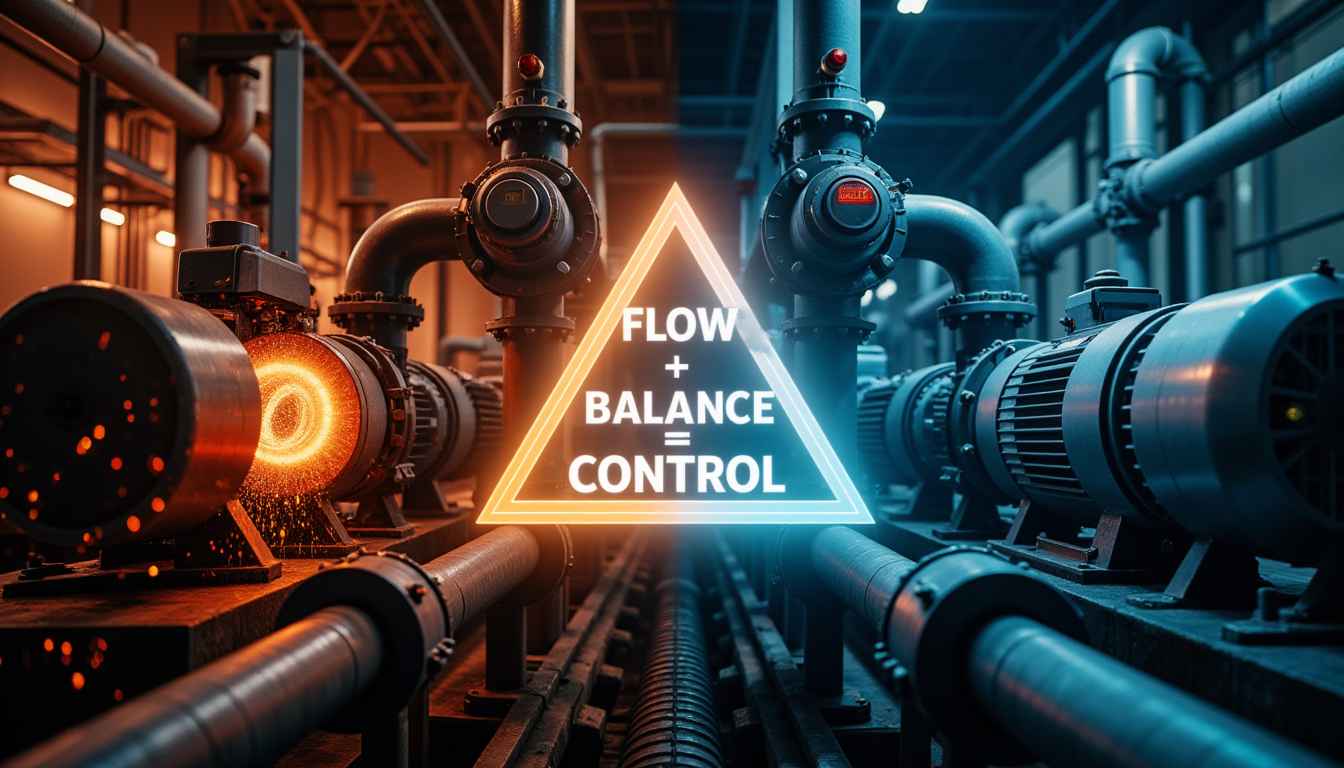
1. Real Case Setup
Let’s step into a real-world scenario that happens every day in industries like water treatment, chemical processing, or cooling systems.
Imagine a pump system designed to transfer liquid—this could be water, chemicals, or cooling fluid—across a process line.
At first glance, everything seems installed correctly. The pump is running. The motor is turning. But operational complaints begin to surface:
Operators report:
- “Flow is too low.”
- “The motor feels hot.”
- “Pressure is unstable—it keeps fluctuating.”
Now, instead of guessing, we look at the basic data available on the pump nameplate and system design:
Typical nameplate / design data:
- Target Flow: 50 m³/h
- Head: 30 meters
- Motor Power: 7.5 kW
This information should define how the system performs. But in reality, the system is not behaving as expected.
What’s happening?
The pump is delivering less flow than required.
The motor is drawing higher current than normal.
Pressure readings are inconsistent.
At this point, many teams jump to conclusions:
- Increase pump size
- Upgrade motor
- Adjust valves randomly
But without understanding the relationship between flow, head, and power, these actions often make things worse.
This is where proper analysis begins—not with assumptions, but with system understanding.
2. Step 1 – Check System Requirements (System Reality)
Before blaming the pump, pause for a moment.
Most pump problems don’t originate from the pump—they come from the system.
This is the first mindset shift:
👉 Don’t ask “What’s wrong with the pump?” — ask “What does the system actually require?”
To understand that, you need to break down the real load imposed on the pump.
🔍 Key Factors to Check
1. Elevation (Static Head)
This is the vertical distance the fluid must be lifted.
- From tank to tank
- From sump to elevated process line
- From ground level to tower or vessel
Even if the system looks simple, elevation alone can significantly affect performance.
But here’s the catch:
Static head is only part of the story.
2. Pipe Length
The longer the pipe, the greater the resistance.
Fluid moving through pipes experiences friction along the walls.
This friction increases with:
- Pipe length
- Flow velocity
- Surface roughness
A system with long piping—even without elevation—can still create high resistance.
3. Valves and Elbows
Every valve, bend, elbow, tee, or fitting adds localized resistance.
Think about:
- Control valves (partially closed = high resistance)
- Multiple 90° elbows
- Check valves
- Filters or strainers
Each component acts like a small obstacle, and together, they can significantly increase total head.
💡 Critical Insight
👉 Head is not just height… it is the total resistance in the system.
This includes:
- Static head (elevation)
- Friction losses (pipes)
- Minor losses (valves, fittings, bends)
So when operators say:
“The pump can’t reach the flow…”
Often the real issue is:
“The system is demanding more head than expected.”
Until you understand this “system reality,” any adjustment you make will be based on guesswork.
3. Step 2 – Estimate the System Curve
Once you understand the components of resistance, the next step is to visualize how the system behaves.
This is where the system curve comes in.
📈 What is a System Curve?
A system curve represents how much head is required at different flow rates.
The key principle is simple:
👉 As flow increases → friction increases → required head increases.
This relationship is not linear—it grows faster as flow increases.
🔄 Simple Behavior of the System
- At low flow → friction is small → head requirement is low
- At high flow → friction rises sharply → head requirement increases significantly
This means:
The system “pushes back” harder as you try to increase flow.
🛠️ Practical Estimation Methods
You don’t always need complex calculations. In real industrial settings, you can estimate the system curve using available data.
1. Field Data (Pressure Gauge)
Check pressure readings at different operating conditions:
- Before and after adjusting valves
- During startup vs steady state
Convert pressure to head (if needed), and observe changes.
2. Flow vs Pressure Trend
If you have flow measurement (flowmeter), compare:
- Flow rate (m³/h)
- Corresponding pressure (or head)
You’ll start to see a pattern:
Higher flow → higher pressure drop
Plotting these points—even roughly—helps you visualize the system curve.
🎯 Main Objective
👉 To understand the “true load” of the system.
Because without knowing the system curve:
- You don’t know how hard the pump is working
- You don’t know why flow is limited
- You don’t know if the pump is correctly sized
This is the foundation for everything that comes next.
4. Step 3 – Match with Pump Curve
Now comes the most important comparison in pump analysis:
👉 System Curve vs Pump Curve
🔍 What is a Pump Curve?
A pump curve shows how the pump behaves:
- Flow vs Head
- Efficiency
- Power consumption
It’s provided by the manufacturer and represents the pump’s capability.
⚖️ Finding the Operating Point
When you overlay:
- The system curve (what the system needs)
- The pump curve (what the pump can deliver)
They will intersect at one point.
👉 That point is called the Operating Point.
This is where the pump will naturally run—no matter what you expect or design.
📍 Why This Matters
At the operating point:
- Flow is fixed by system resistance
- Head is fixed by system demand
- Power is determined by that condition
You cannot force the pump to operate outside this balance without changing the system.
⚠️ Real-World Reality
In many plants, the operating point is not ideal.
👉 Most systems operate far from the Best Efficiency Point (BEP).
What happens when operating away from BEP?
- Efficiency drops
- Energy consumption increases
- Vibration may increase
- Mechanical wear accelerates
- Motor load becomes unstable
💡 Common Scenario
You expect:
- 50 m³/h at 30 m head
But actual operation is:
- 35 m³/h at 40 m head
Why?
Because the system curve is steeper than expected.
The system is demanding more head → reducing flow → increasing load on the pump.
🎯 Key Insight
👉 The pump does not decide the flow—the system does.
And the only way to control performance is by understanding and adjusting the balance between:
- System resistance
- Pump capability
This is the turning point in pump troubleshooting—from guessing… to engineering.
5. Step 4 – Check Power & Motor Load
After understanding the system curve and matching it with the pump curve, the next critical step is to verify what’s happening on the motor side.
Because in reality, power is the price you pay for moving fluid.
🔍 What to Check
1. Motor Current (Ampere)
This is the fastest and most practical indicator in the field.
- Measure actual running current
- Compare with motor rated current (nameplate)
If the ampere is:
- Higher than rated → risk of overload
- Close to maximum → system is operating near limit
- Too low → possible underloading or low flow
2. Motor Nameplate Power (kW)
Check:
- Rated power (kW)
- Service factor (if available)
Then estimate actual power usage based on current and voltage.
Even without perfect calculation, trends are enough:
- Increasing current = increasing power consumption
⚠️ Common Field Scenario
Operators often try to increase flow:
- Opening valves
- Reducing restrictions
At first, it seems correct:
“More flow is better.”
But what actually happens?
👉 As flow increases → required power also increases
Why?
Because:
- Higher flow = higher velocity
- Higher velocity = higher friction losses
- Higher friction = more energy required
💡 Critical Insight
👉 There is no such thing as “free flow”… it is always paid with power.
Every additional m³/h:
- Requires more energy
- Increases motor load
- Pushes the system closer to its limit
🚨 Hidden Risk
If not monitored:
- Motor overheating
- Frequent tripping
- Reduced motor lifespan
- Increased energy cost
So before increasing flow, always ask:
“Can the motor handle the extra load?”
6. Step 5 – Adjust Flow (Real Methods in the Field)
Once you understand the relationship between flow, head, and power, the next step is control.
In real operations, you don’t redesign the system instantly—you adjust it using available tools.
🛠️ Practical Options
1. Throttling Valve (Control Valve)
The most common and quickest method.
- Partially close a valve to reduce flow
- Increases system resistance
- Shifts operating point to lower flow
✅ Pros:
- Fast and simple
- No additional equipment required
❌ Cons:
- Wastes energy (extra head is “burned” in the valve)
- Pump still runs at same speed
2. Open/Close Valves (System Adjustment)
Sometimes the issue is:
- Too many restrictions
- Incorrect valve position
Actions:
- Fully open unnecessary restrictions
- Remove bottlenecks
This reduces system resistance and allows better flow.
3. Impeller Trimming
This is a mechanical modification.
- Reduce impeller diameter
- Decreases head and flow capability
✅ Pros:
- Permanent energy savings
- Better matching to system
❌ Cons:
- Requires shutdown
- Not easily reversible
4. Variable Frequency Drive (VFD)
The most advanced and efficient method.
- Adjust motor speed
- Directly controls pump performance
Effects:
- Lower speed → lower flow, head, and power
- Higher efficiency at varying demand
⚖️ Comparison
Throttling
- Quick solution
- Low cost
- But inefficient (energy loss as heat)
VFD
- High efficiency
- Precise control
- But higher initial investment
💡 Practical Insight
If the system:
- Frequently changes demand → use VFD
- Is stable but slightly oversized → consider impeller trim
- Needs quick temporary adjustment → use throttling
There is no one-size-fits-all solution—only the right balance for your system.
7. Step 6 – Rebalance (Flow vs Head vs Power)
After making adjustments, many people stop here.
That’s a mistake.
Because every change shifts the balance—and you must verify the new condition.
🔁 What to Recheck
After adjustment, always measure again:
1. Flow
- Is it meeting the target?
- Is it stable?
2. Pressure (Head)
- Has it increased or decreased?
- Is it consistent?
3. Motor Current (Ampere)
- Is it within safe limits?
- Any signs of overload?
🎯 Target Condition
The goal is not just “make it work.”
The goal is:
- ✅ Flow meets process requirement
- ✅ Motor is not overloaded
- ✅ System is stable
- ✅ Pump operates near Best Efficiency Point (BEP)
📍 Why BEP Matters
Operating near BEP ensures:
- Maximum efficiency
- Minimum vibration
- Longer equipment life
- Lower energy cost
🔄 The Balancing Mindset
Instead of thinking:
“Increase flow”
Think:
“Balance flow, head, and power”
Because:
- Increasing flow increases head demand
- Increasing head increases power consumption
- Increasing power stresses the motor
💡 Final Insight for This Step
👉 A pump system is not about maximizing one parameter—it’s about balancing all three.
And this balance is dynamic:
- It changes with system conditions
- It requires continuous monitoring
- It demands engineering judgment
Once you master this step, you move from reactive troubleshooting… to controlled optimization.
8. Common Mistakes
Even experienced operators and engineers fall into the same traps when dealing with pump systems. These mistakes are subtle—but they are the reason why many systems remain inefficient, unstable, or overloaded.
Let’s break down the most common ones.
❌ 1. Focusing Only on Flow
This is the most frequent mistake.
When performance drops, the immediate reaction is:
“We need more flow.”
So what happens?
- Valves are opened
- Restrictions are reduced
- System is pushed harder
But no one checks:
- What happens to head?
- What happens to power?
👉 Increasing flow without considering head and power is like pressing the gas pedal without checking engine limits.
Result:
- Motor overload
- Energy waste
- System instability
❌ 2. Ignoring the System Curve
Many decisions are made based only on pump specifications.
People look at:
- Pump capacity
- Nameplate data
But forget:
👉 The pump does not operate alone—the system defines the operating point.
Without understanding the system curve:
- You don’t know the real resistance
- You don’t know why flow is limited
- You can’t predict system behavior
This leads to trial-and-error adjustments instead of engineering decisions.
❌ 3. Over-Throttling
Throttling is often used as a quick fix.
But excessive throttling creates a hidden problem:
- Artificially high resistance
- Energy loss across the valve
The pump still produces energy—but instead of being useful, it is wasted as heat.
Result:
- High power consumption
- Reduced efficiency
- Unnecessary operational cost
👉 Throttling solves control problems, but it does not solve efficiency problems.
❌ 4. Wrong Pump Selection from the Beginning
Sometimes, the issue is not operational—it’s fundamental.
The pump was selected based on:
- Incorrect assumptions
- Incomplete system data
- Safety margins that are too large
Common outcomes:
- Pump too big → excessive throttling required
- Pump too small → cannot reach target flow
- Operating point far from BEP
And once installed, the system is forced to adapt to a poor decision.
💡 Key Takeaway
Most pump problems are not caused by failure…
They are caused by misunderstanding.
9. Simple Mental Model
To truly understand pump systems, you need a simple but powerful way of thinking.
Here’s the model:
👉 A pump is not a flow machine… it is an energy machine.
⚡ What Does That Mean?
A pump does not “create flow” freely.
Instead, it:
- Transfers energy to the fluid
- That energy is used to overcome system resistance
Flow is simply the result of that energy interacting with the system.
🔗 The Three Variables Are Always Connected
There are three key parameters:
- Flow
- Head
- Power
And they are always linked:
👉 Flow ↑ → Head ↑ → Power ↑
You cannot change one without affecting the others.
🔍 Practical Interpretation
If you try to:
- Increase flow → system resistance rises → pump must work harder → power increases
If you:
- Reduce resistance → flow increases → power demand changes
Everything is connected.
💡 Why This Model Matters
It prevents wrong decisions like:
- Forcing flow without checking power
- Reducing head without understanding system impact
- Oversizing equipment unnecessarily
Instead, it trains you to think in balance—not in isolation.
10. Closing
Let’s bring everything together.
🔁 Recap
When dealing with pump systems:
- Don’t look at the pump alone
- Always evaluate the entire system
- Understand the system curve
- Compare it with the pump curve
- Monitor power and motor load
Because performance is not determined by one component—it’s defined by the interaction of all elements.
⚖️ The Core Principle
Every pump system operates based on balance:
- Flow
- Head
- Power
Ignore one, and the system becomes unstable.
Control all three, and the system becomes efficient.
💬 Final Punchline
👉 You don’t control the pump… you control the balance.
And once you understand that, you stop guessing—
and start engineering.
11. Sumary
Balancing flow, head, and power is the key to understanding and optimizing any pump system. Most operational problems—whether it’s low flow, unstable pressure, or motor overload—are not caused by the pump itself, but by a mismatch between what the system demands and what the pump delivers.
The journey starts with a critical mindset shift:
👉 Stop blaming the pump, and start understanding the system.
Every system has its own resistance, built from elevation, pipe length, and components like valves and elbows. This resistance defines the system curve, which determines how much head is required at different flow rates. When this curve is matched with the pump curve, the system naturally finds its operating point—whether ideal or not.
In reality, many systems operate far from their Best Efficiency Point (BEP), leading to energy losses, mechanical stress, and higher operating costs.
Another key takeaway is that power is always involved. Increasing flow is never free—it always comes with increased energy demand. Monitoring motor load, especially through ampere readings, provides a direct insight into how hard the system is working.
When adjustments are needed, there are practical options:
- Throttling valves for quick control (but less efficient)
- Impeller trimming for permanent optimization
- VFDs for precise and energy-efficient control
However, every adjustment must be followed by rebalancing:
- Check flow
- Check pressure
- Check motor load
The goal is not just to make the system run—but to make it run efficiently, safely, and close to BEP.
Many common mistakes—such as focusing only on flow, ignoring system behavior, or over-throttling—come from a lack of holistic understanding.
That’s why the most important concept to remember is:
👉 A pump is not a flow machine—it is an energy machine.
Flow, head, and power are always interconnected. You cannot change one without affecting the others.
